Functional CAD design

Can It Actually Work?

Synthesizing Functional CAD Mechanisms

Wenqian Zhang1,†Yangyi Huang2,†Zigeng Xu1,†Weiyang Liu2,‡Zhen Liu1,‡,*

1The Chinese University of Hong Kong (Shenzhen)2The Chinese University of Hong Kong

†Equal contribution‡Equal advising*Corresponding author

3D-printed prototypes of AI-generated designs

A CAD model can look right and still fail. We ask agents to build mechanisms that pass physics tests.
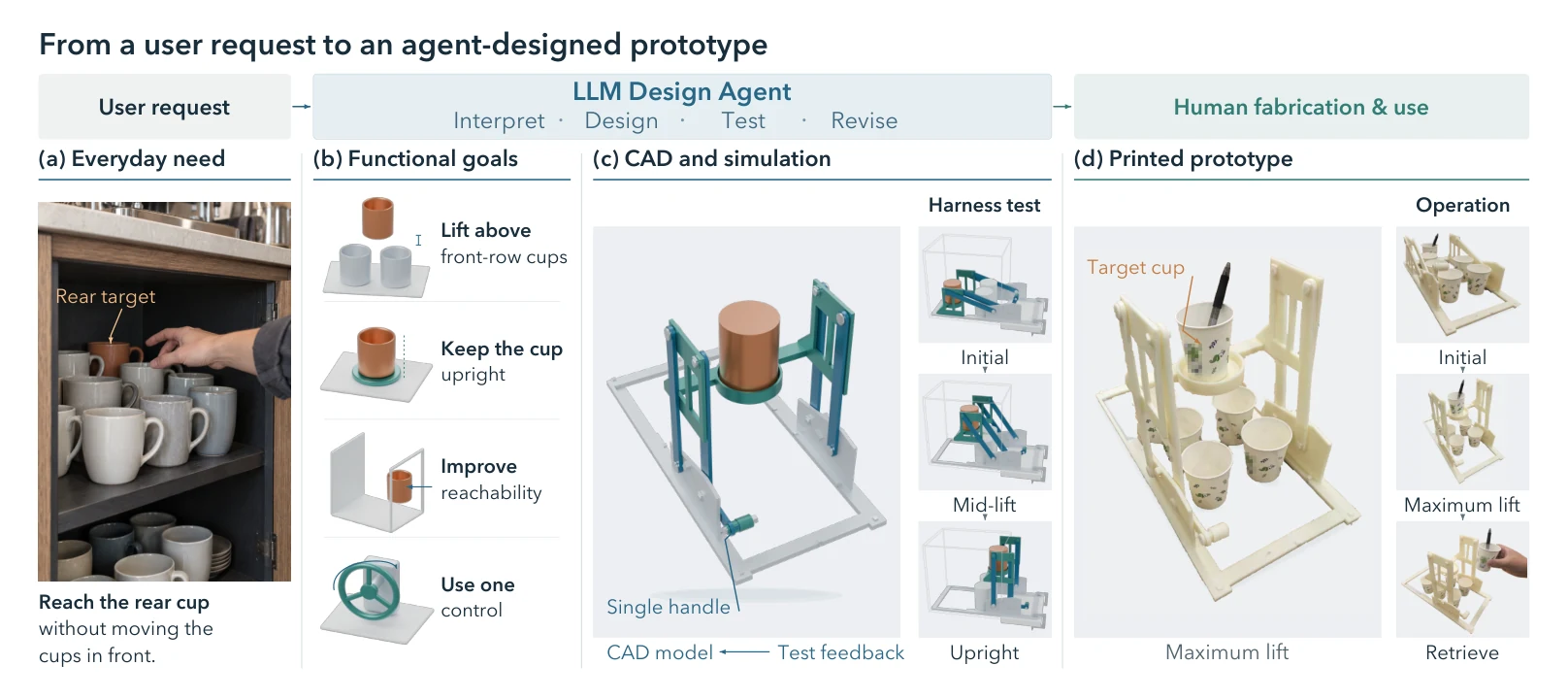
Paper Figure 1: a cup-access request becomes functional goals, an agent-built CAD model tested in simulation, and a printed prototype
Figure 1. From a user request to a printed, working prototype.
46mechanism families
75agent-built assemblies
8→22Astra tasks solved: simulation tools → full harness
36/46Grok with retained history, ≤8 attempts
01 · The problem

Looks right. Doesn’t work.

Plausible assemblies can hide interference that blocks the function.
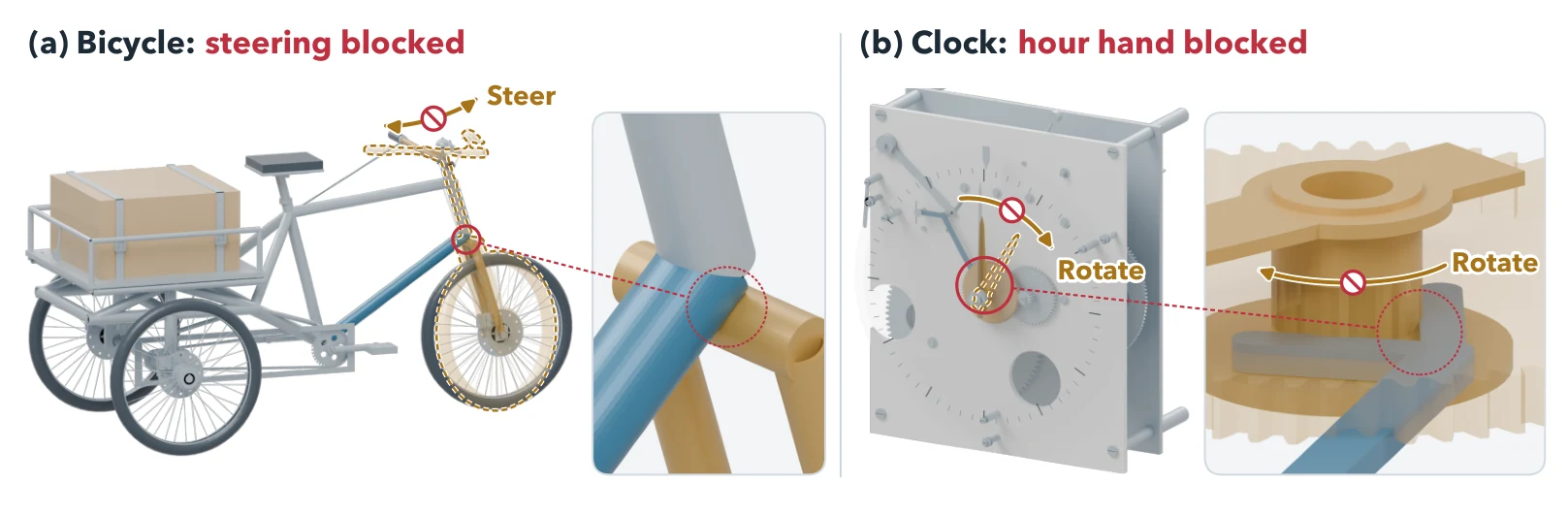
Paper Figure 7: an Astra bicycle whose steering intersects the frame, and an Astra clock whose hour wheel overlaps the alarm lever
Figure 7. Astra designs produced without harness feedback.
Loading 3D…
Cargo bicycle · AstraSteering blocked
Drag to orbit
Loading 3D…
Alarm clock · AstraHour hand blocked
Drag to orbit
02 · FunCAD-Harness

Test the function, not the look.

Each requirement becomes a physics test bound to the candidate’s own parts.
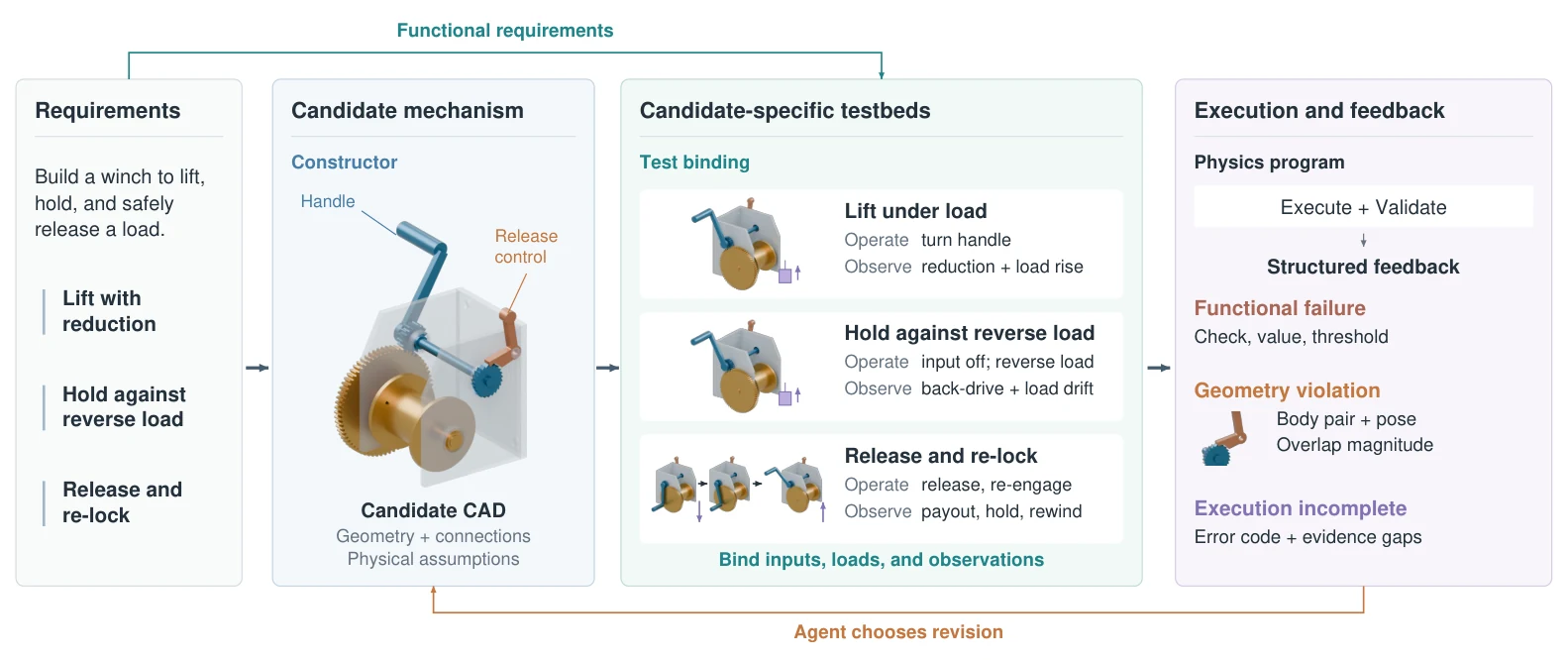
Paper Figure 5: FunCAD-Harness connects functional requirements, a candidate mechanism, candidate-specific testbeds, and execution feedback, illustrated with a releasable winch
Figure 5. Requirements → candidate-specific tests → diagnostic feedback.
  1. RequirementsWhat it must do
  2. ConstructionCAD, joints, assumptions
  3. Test bindingTests fit this candidate
  4. ExecutionRigid-body physics + audits
  5. RevisionDiagnose and repair
03 · In simulation

Every candidate runs its own test.

Replays of recorded FunCAD-Harness tests from our experiment archive · original CAD geometry, display colors.

One task, four designs

Task 22 · slider-crank push rod · every build passes

Drum crank · 9 parts · 44 mmGrok
Handwheel · 16 parts · 40 mmFable
Pedestal crank · 8 parts · 36 mmKimi
Twin guide shafts · 24 parts · 44 mmAstra

Same requirements, four passing designs, each replayed from its recorded loaded test on original CAD geometry in display colors. The last two crank turns of every test are scaled to one common loop, so playback is not real time and speeds are not comparable. Captions give part count and stroke under load.

04 · Revision

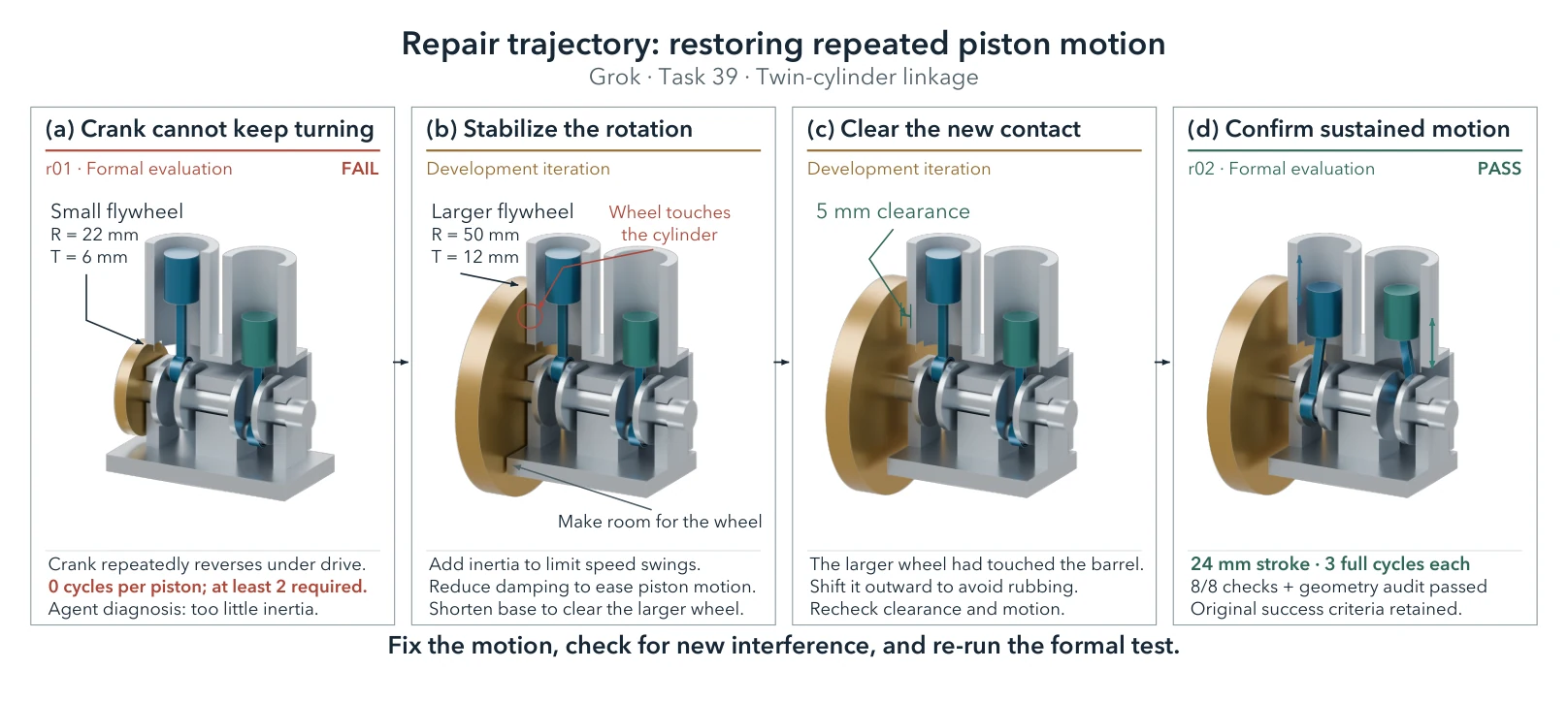
Fail. Diagnose. Repair.

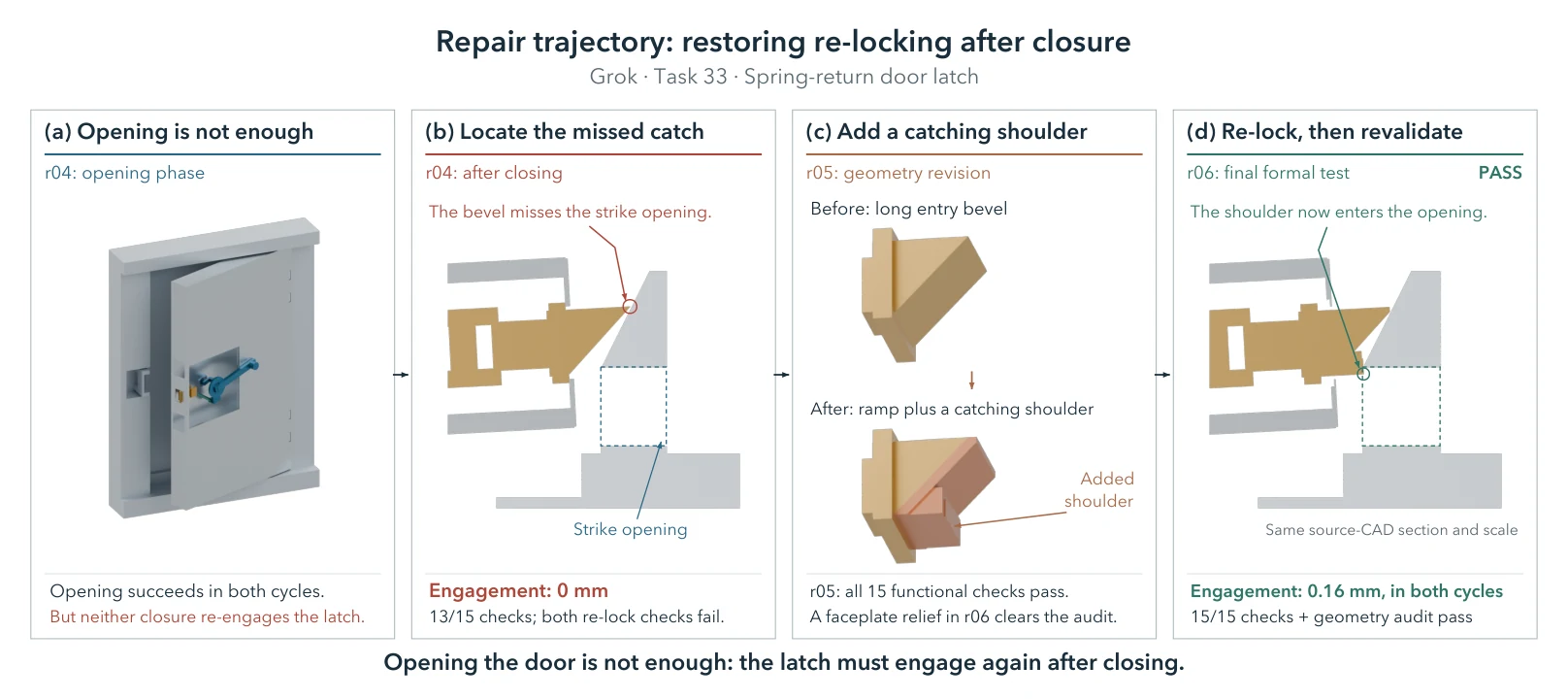
Physical feedback tells the agent what broke, so the next revision fixes it.
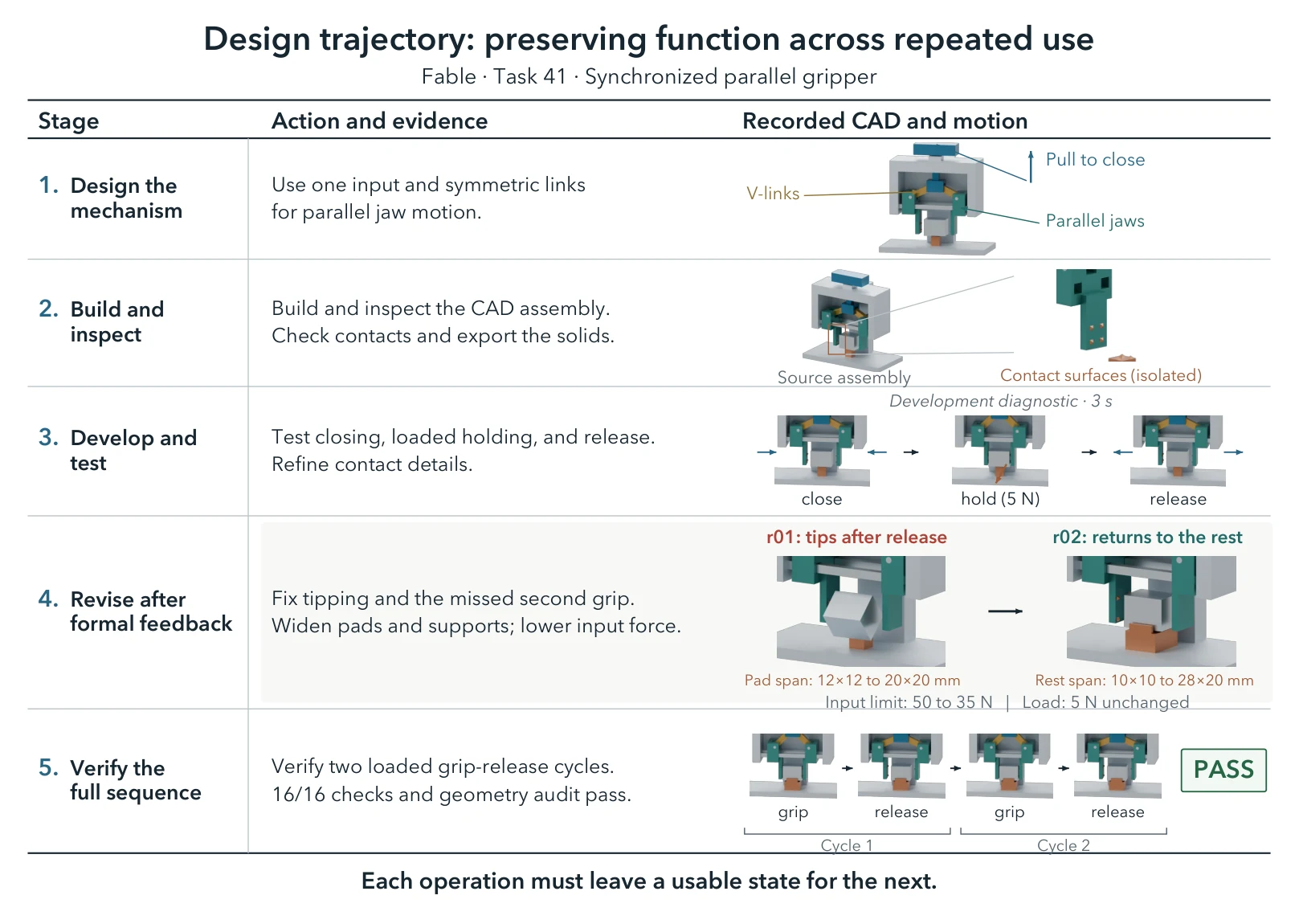
Paper Figure 9: Fable's design trajectory for the synchronized parallel gripper, from construction to a repaired design that passes repeated grasp-release cycles
Figure 9. Synchronized parallel gripper, revisions r01 → r02.
r01 · piece tips overFail
r02 · grasps twicePass
  1. Second grasp misses · 0 N of 10 N
  2. Wider pads and rest, 35 N input limit
  3. Second grasp 14.4 N · both cycles pass
05 · Real world

Printed. Assembled. Working.

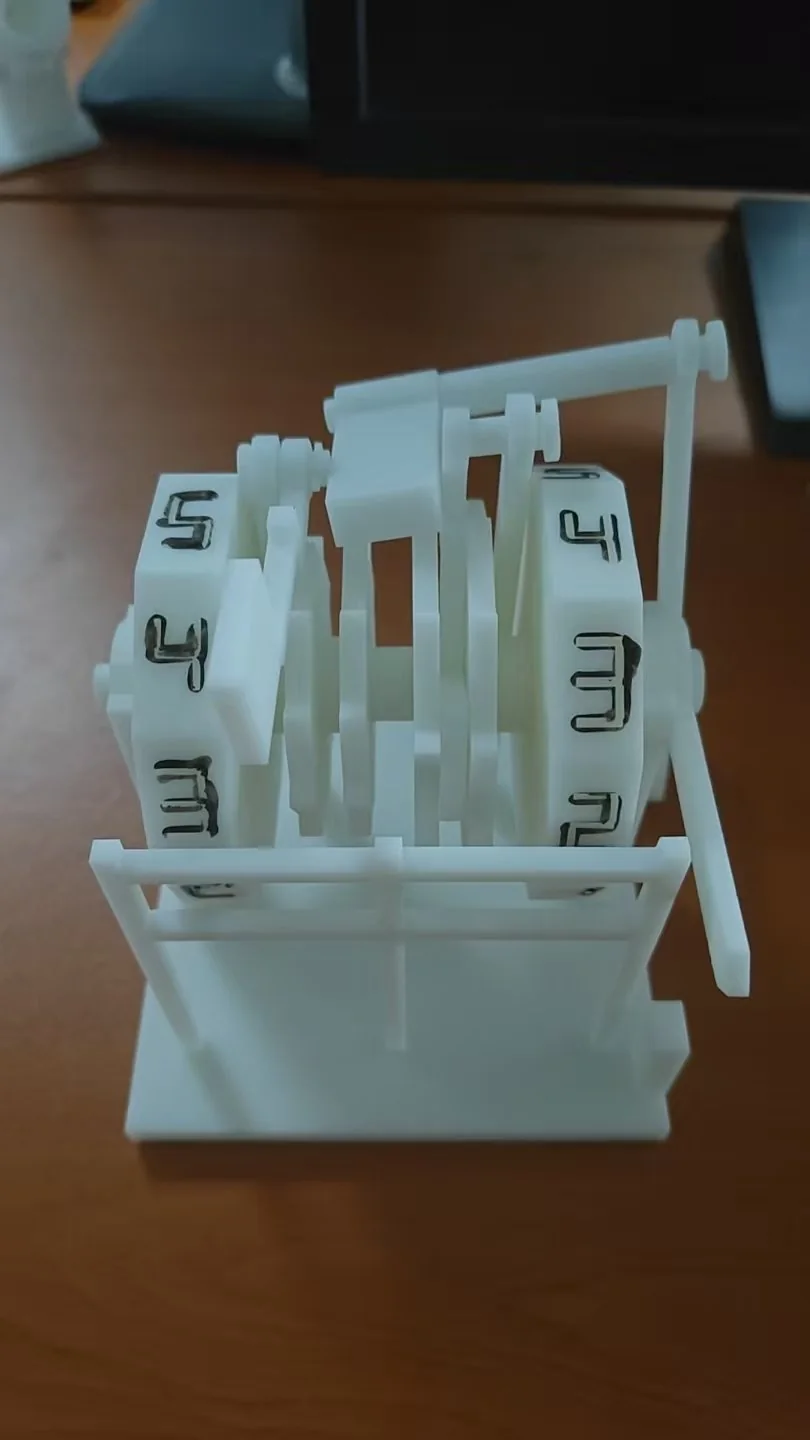
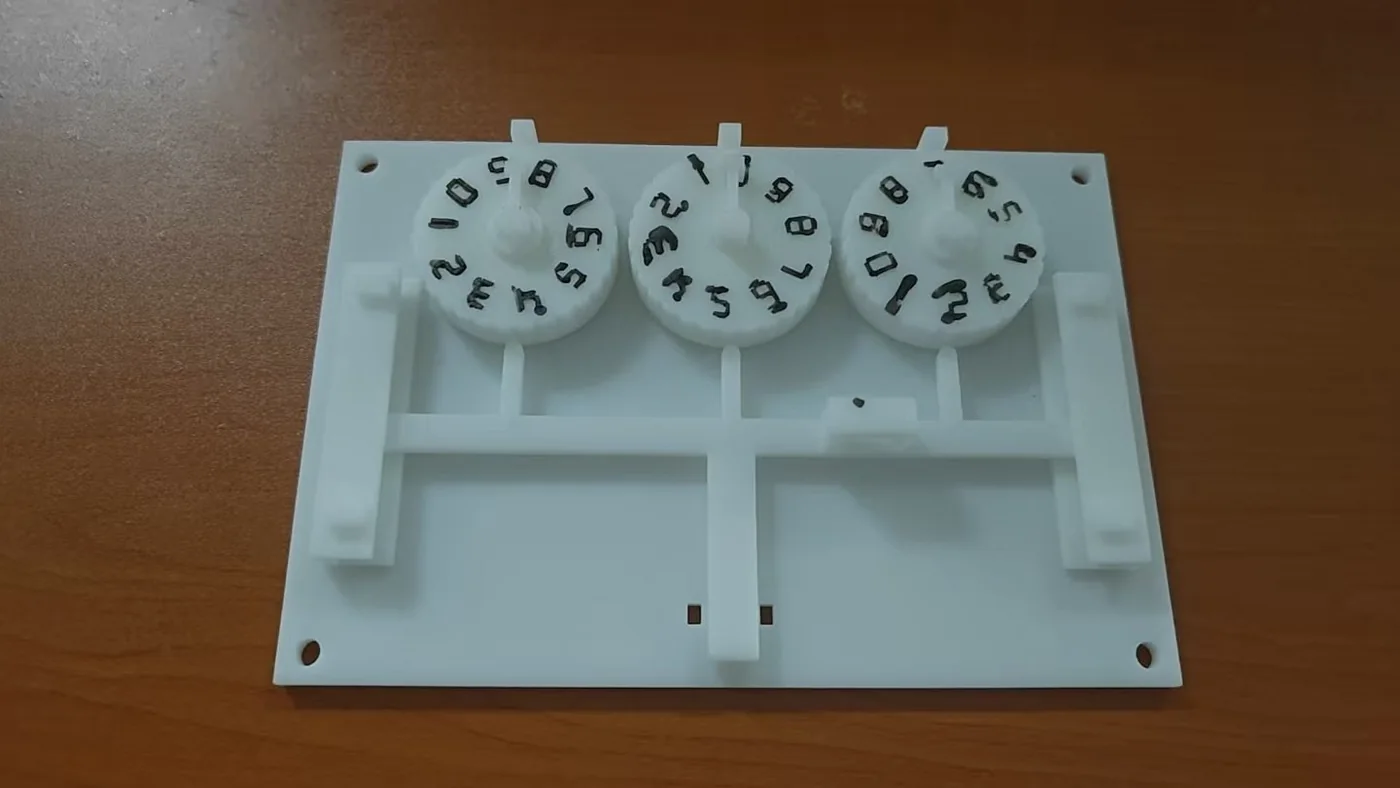
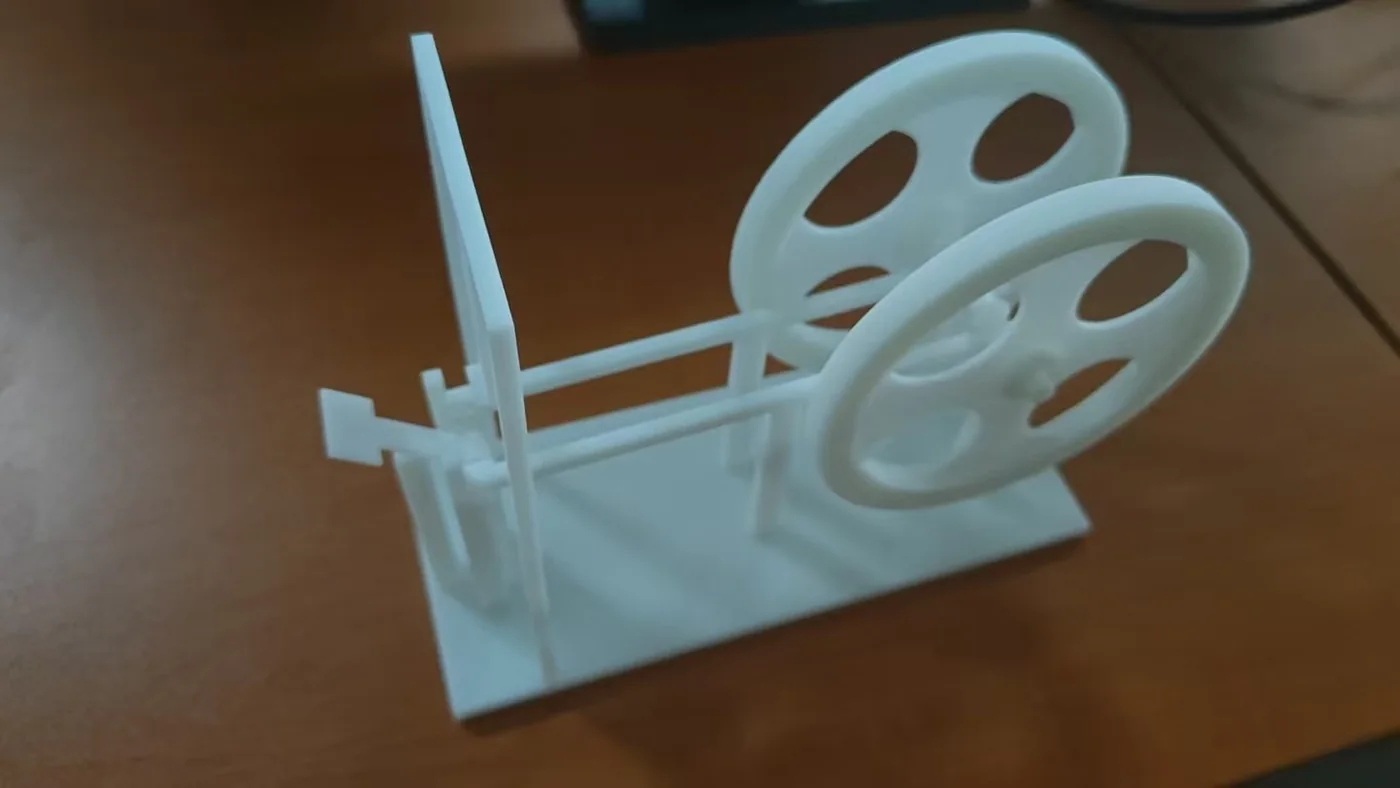
3D-printed prototypes of AI-generated designs.
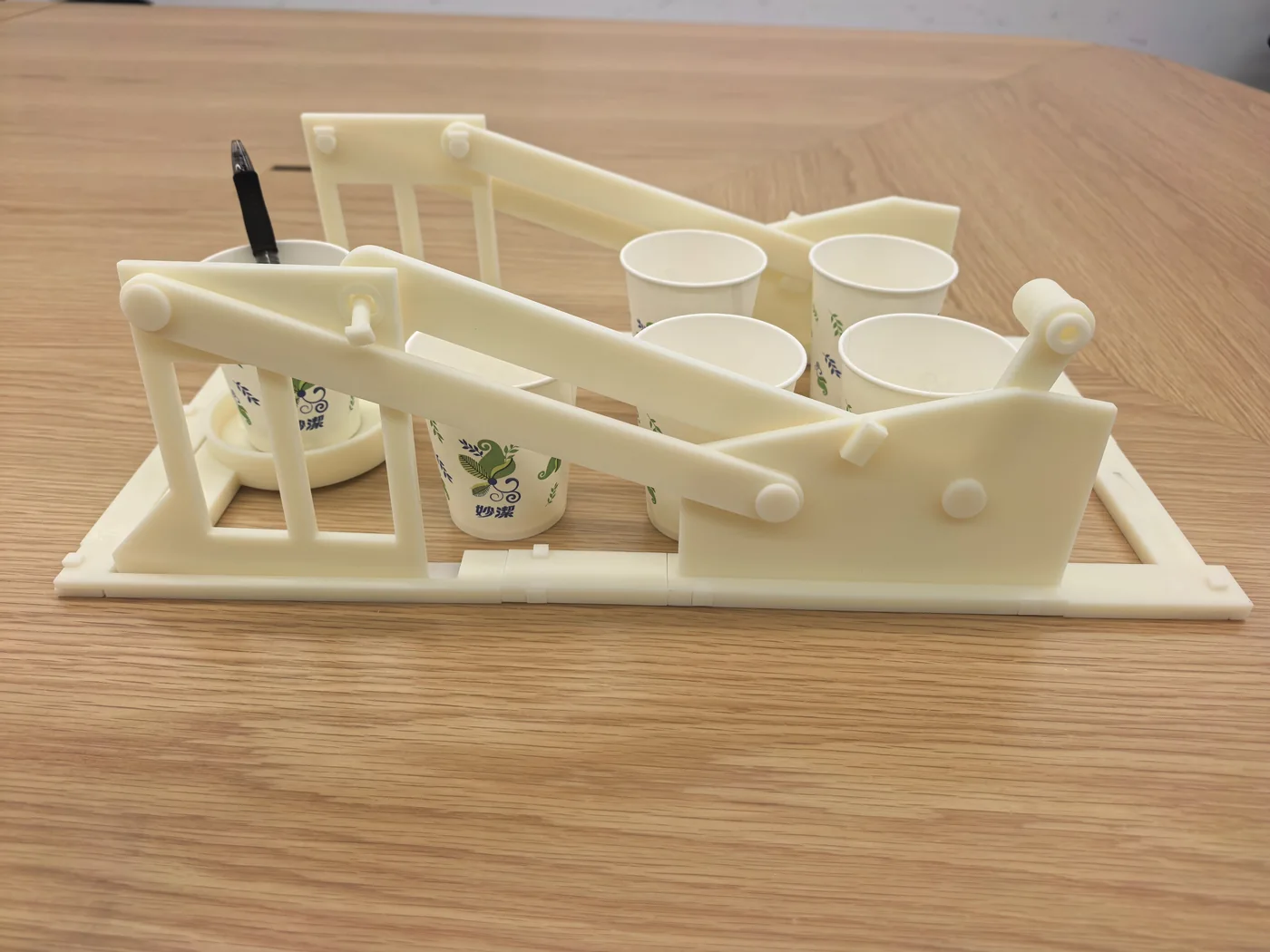
Cup-access machineOpen-ended
PistonTask 17
Two-digit counterTask 19
Gravity timerTask 21
Combination lockTask 18
Ball dispenserTask 20
Printed cup-access machine with its target cup at the rear
Printed two-digit counter showing its digit wheels
Printed three-digit combination lock with numbered code wheels
Printed gravity timer assembly
06 · FunCADBench

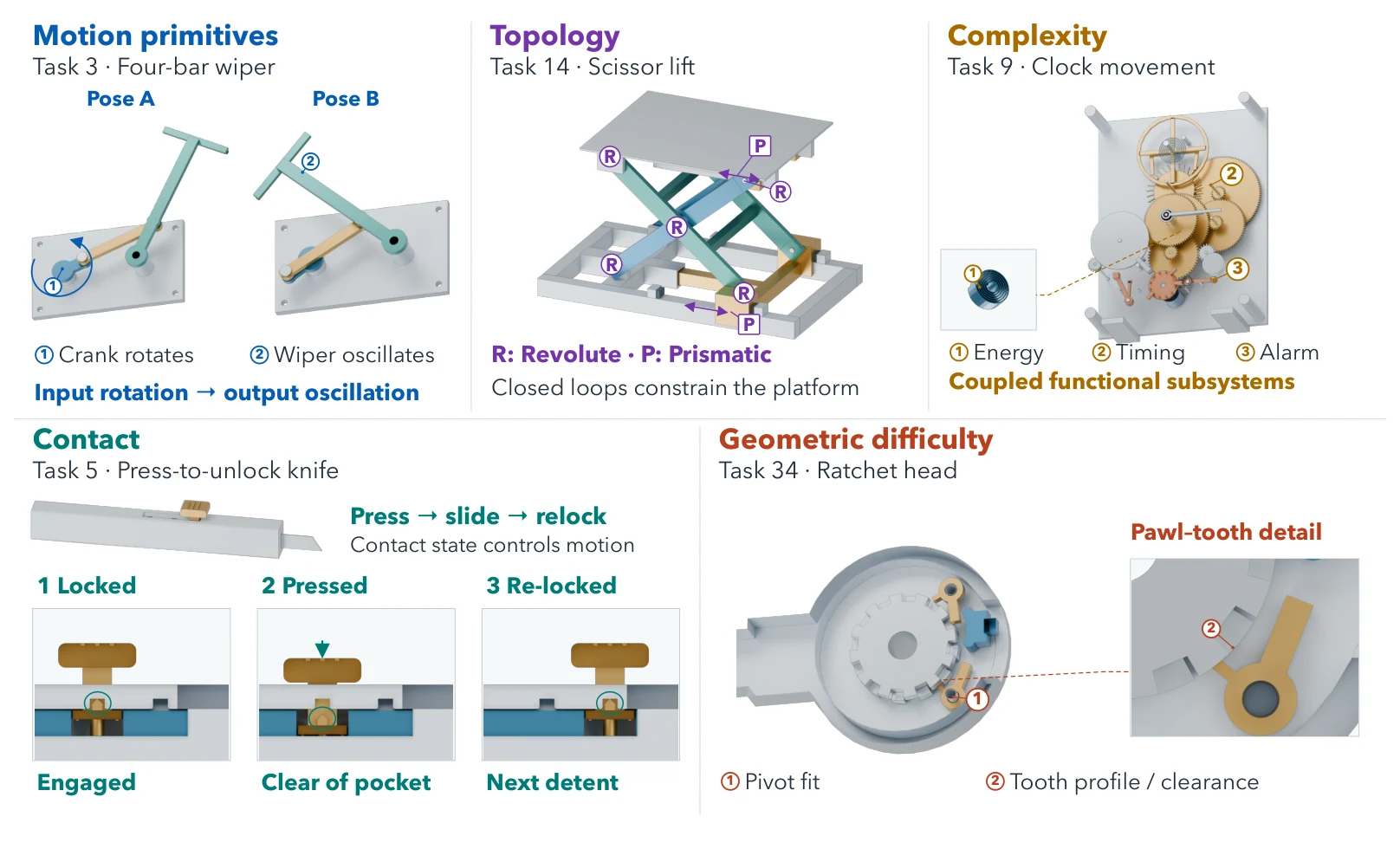
46 mechanism families.

From clamps and transmissions to clocks, counters, and coin sorters.
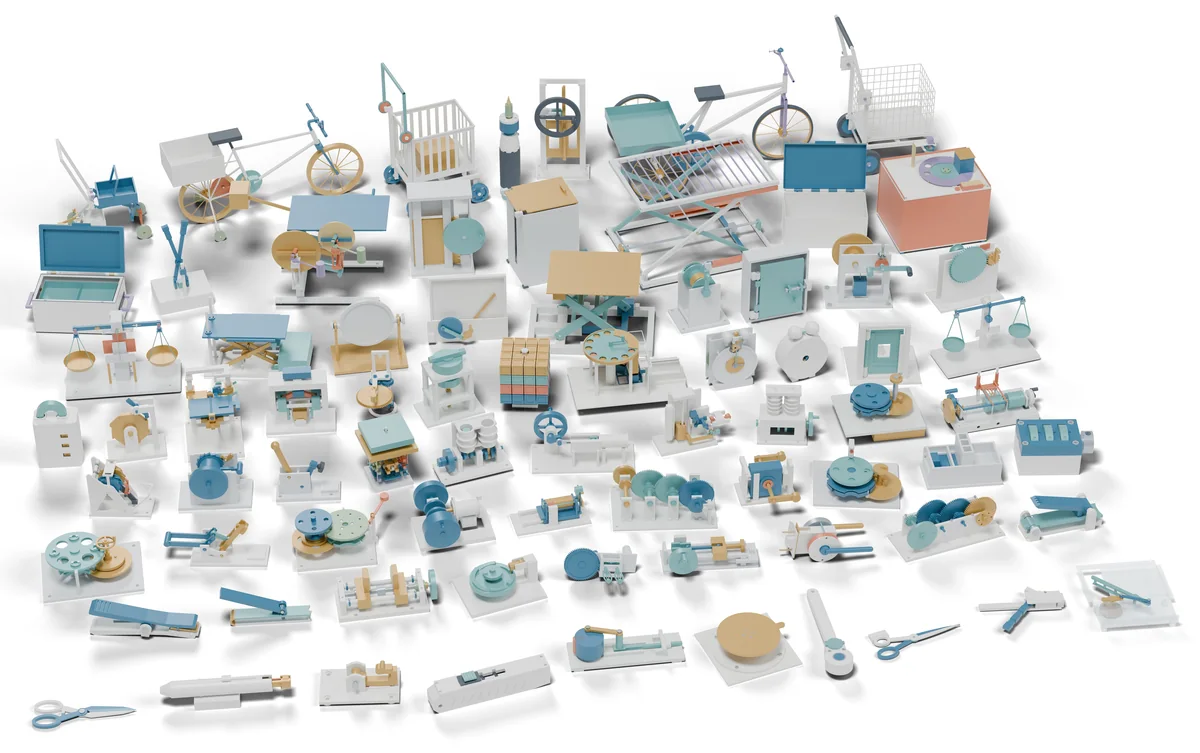
Paper Figure 3: 75 mechanisms built by LLM agents across all 46 FunCADBench families
Figure 3. 75 agent-built assemblies covering all 46 families.
Paper Figure 2: FunCADBench taxonomy with representative mechanisms for motion primitives, topology, complexity, contact, and geometric difficulty
Figure 2. Five axes of mechanical demand.

Browse the builds

Every passing build in the main benchmark, rendered from its delivered CAD · tap to enlarge

All 46 families

Highlight by demand axis

07 · Results

Physics feedback makes better designers.

Tasks solved

out of 46 · full harness

Under each name: median active time · est. API cost per task.

What the harness adds

tasks solved
AstraGrok
8 → 22Astra, from simulation tools to the full harness.
22 → 0Astra when feedback is reduced to pass/fail.
36/46Grok with retained history (≤8 attempts), at half of Astra’s API cost.
Resources

Dig deeper.